
Jack Dibden
Level Design Theory
Dissertation – Core Research breakdown
Planning
Molecular Design
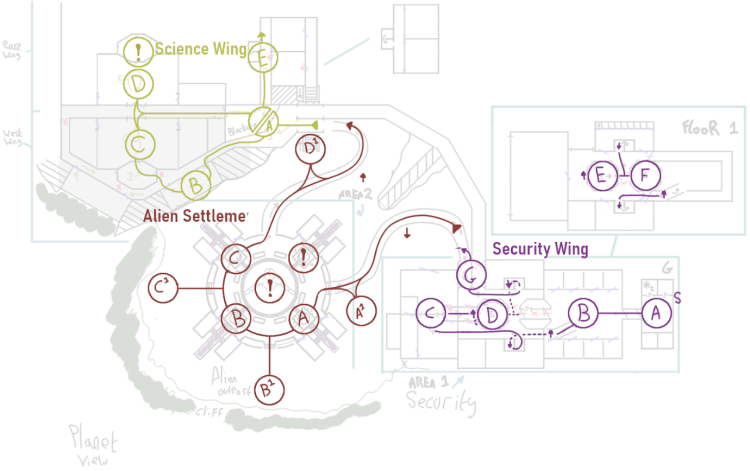
Molecular design is a planning method that puts key locations and how they connect first. The idea creators, McMillan and Azar suggest using Nodes to represent key locations. This could be Spawn, Story, or Important locations that have some sort of connection.
These Nodes are linked with edges that dictate where the nodes connect in physical space. While they suggest these edges to be player-oriented, they can be used to create connections that are related to other ties, such as story, relation, etc.
Within my dissertation ‘Edges’ were used to plan the player route. This specifically needed a route that guided the player through each major location at least once without it being missed. In the above image, we can see the planned route taking the player through two buildings and an external area with a fixed path the player can take.
I also use this method when planning my DnD worlds and maps. Below is a step-by-step process of planning a 2D map with some basic ideas and a story planned.
This was planned to be a Steampunk-like fantasy, where the players are a bandit ring that is forced out of their home and have to escape to the capital city for safety due to an apocalyptic event.
The plan starts with a few basic ideas I had prepared. I knew I needed to focus on cities, due to the main map being the overview of a country. I started with some stereotypes or requirements for major locations I needed:
• The Capital – The final destination
• The Bandit Camp – The starting location
• Apocalyptic pressure point – The driving force to push the players along
• Blockers / Challenges – Things the players need to overcome to make the situation challenging and fun.

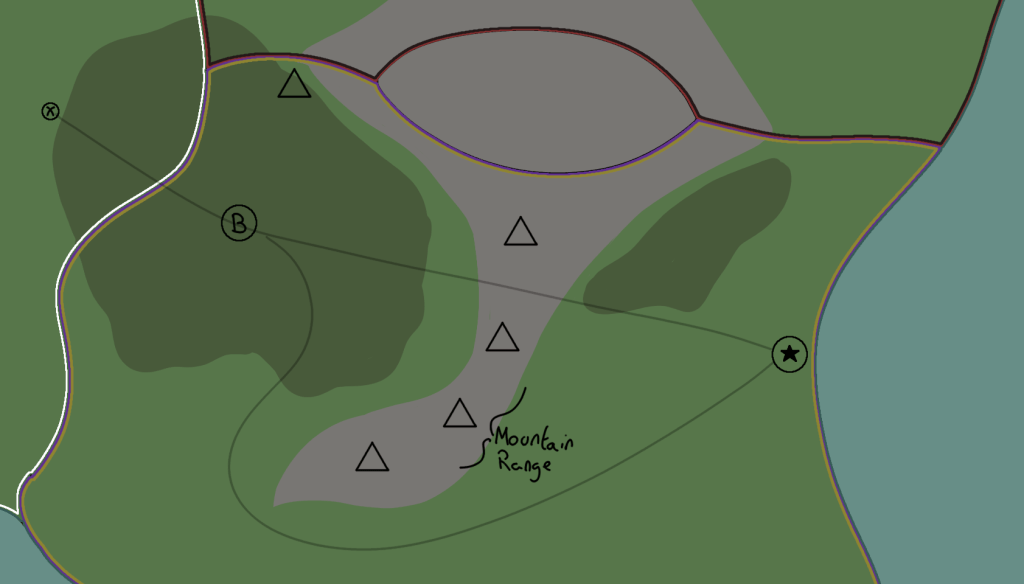
I started drawing the borders of the country to limit players wandering off the path too much, acting as natural world borders. The other borders are countries that the player won’t be able to reach due to the location of the apocalypse point.
This leaves the player with two options: go through the blocker or go around it. These are shown with the faded ‘edges’.
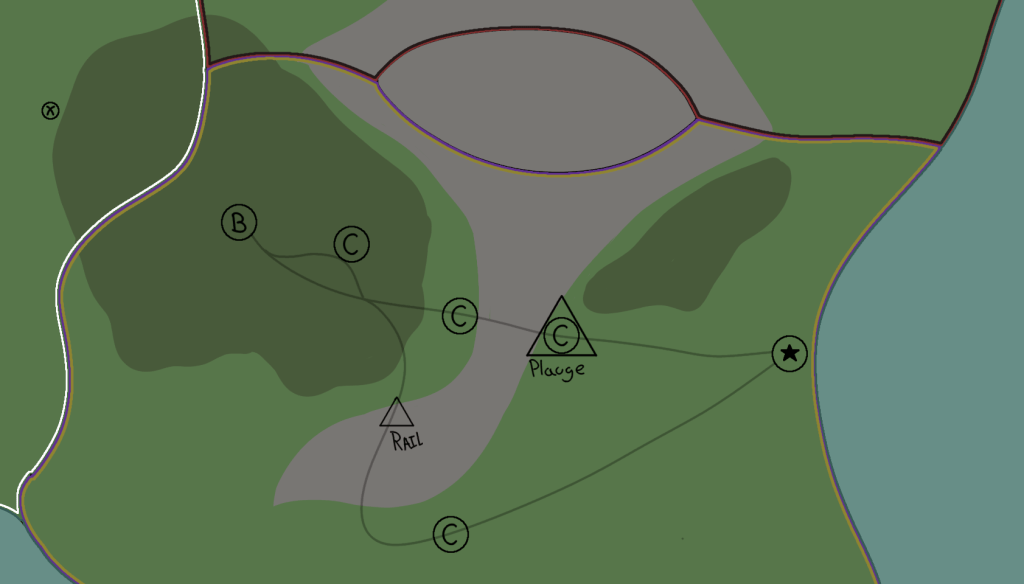
However, this is far from complete. A country demands more than a single capital and a bandit camp. Considering the edges drawn out, points of interest were added along them.
Adding some Towns or Cities (marked with C) we can start adding some detail to this world as well as making the challenges the players face more interesting.
One offers using a railway to cut through some mountains to race to the capital, while the other suggests taking the most direct route, however, they would have to survive a plagued city without being infected.
Now these cities need to exist for a reason. In the medieval era, they generally have a main role within a country, be it a strategic or resource-heavy location.
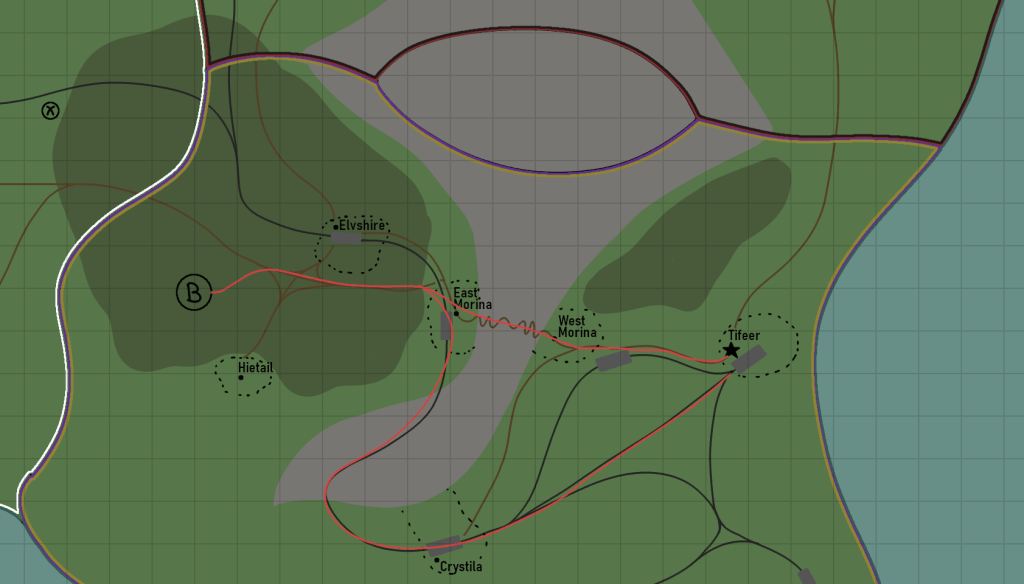
With the map set, these locations have a level of depth and a plan, the next step was to disguise this from the players for the players to discover. Other paths and railways were added to make the planned path look more natural, yet useless to the players immediately, showing different routes that have appropriate reasoning within the world.
here we can see the completed world map of the main cities. One benefit open-ended RPGS have is intense flexibility at the game masters digression, which is I have left lots of room between cities for key locations that would be flexible to plan ahead for.


White boxing
A planning method to see what areas would look like in three-dimensional space using basic shapes. Designed to help discover issues or unintended interactions that a 2D plan may have overlooked.
Layers of Detail
Level designing is all about layering on detail at every stage of development, especially when it comes to working with art and narrative. A solid layering system ensures that whatever the project values are first while ensuring that the other important factors are not forgotten and lost.
While it changes per project and needs, these are my go-to standards:
• Functionals
The core fundamentals of the level that need to be achieved. Mechanics that are non-negotiable, major story beats that are inflexible. Things that can be achieved and showcased in Blockout
• Reinforce
Layer additional details that reinforce the core with other elements, using the flexible parts of the block out and core design and adapting them to maximise the space
• Enhance
Use UX testing and playthroughs to enhance intended effects and techniques and make adjustments to finalise the level section

Environmental Story Telling
The one thing that I learned is everything can used as a canvas. Every surface can have meaning, be it simply thematic or integral to a greater story. Even the shape, size, position, location and state can (and should!) work with each other to build a world.
Words and Images
This is the most simple, obvious and common type of environmental storytelling. By directly displaying information to the player by embedding it in the world via artefacts or space itself we can tell the player information directly.
This can be done literally, with examples such as readable notes, nameplates, or posters. Or use expected stereotypes such as lighting colour and direction or character dress design.
Players often must use basic reasoning or logic to put information together. For example, we can display the love between two characters, in decreasing subtlety:
• A note, talking about their love.
• A drawing of the two together.
• Notes from other characters talking about their friendship.
• The characters’ initials within a love heart carved into another character’s desk.
Messages in Signs
Signs in this context are the idea of a thing holding an idea or message based on the player’s expectations or experiences. These can be split into three categories:
• Icons, which show events by recreation, such as photographs, recordings, drawings or acting.
• Indices, which indicate events with physical signs that have natural relations, such as arrows indicating direction of travel
• symbols, which relate to events via repetition and social agreement, such as a company logo denoting the company’s relation to the object it’s on.
Localised Stories (Micro narratives)
Localised stories, or ‘micro narratives’ are localised incidents within a story that leave evidence of its existence within the game world.
These incidents have little rules or limits on what they can be. They can be happening right now, such as a child crying behind a locked door, or the remains of the past, such as blood trailing into a vent.
Using these small localised stories, we can display new or reinforce pre-existing information using embedded models, textures, animations, sounds and other assets.
Branching off Expectations
Using existing stereotypes from the real world can help immerse the player into the world they are in. This primarily is used to help familiarise the player with what they should expect and what should seem out of place
For example, steel girders, metal scaffolding and construction equipment should indicate to the player they’re on a construction site, which would make the player note something such as unicorns or demonic icons out of place and significant points of interest.
This ties into the importance of the player knowing where they are as soon as possible to pull players into the world and story we create for them.
Physical Visual Design
Objects or architecture itself can be designed to have meaning or tell a story. This link between visuals and story can be spiritual, practical or emotional. A real-world example is the Taj Mahal. It was designed off someone’s love for their past wife. The tomb was built with precise proportions and its gardens and waters were representing the four rivers of paradise to represent what the women meant to the individual.
Using this idea we can help build the entire game world based on the thematic content within. For example, the design of buildings can change based on era, location, wealth, and culture, having the locations themselves tell a story about the characters that inhabit them and the external factors that have shaped them.
 Jack Dibden's Portfolio